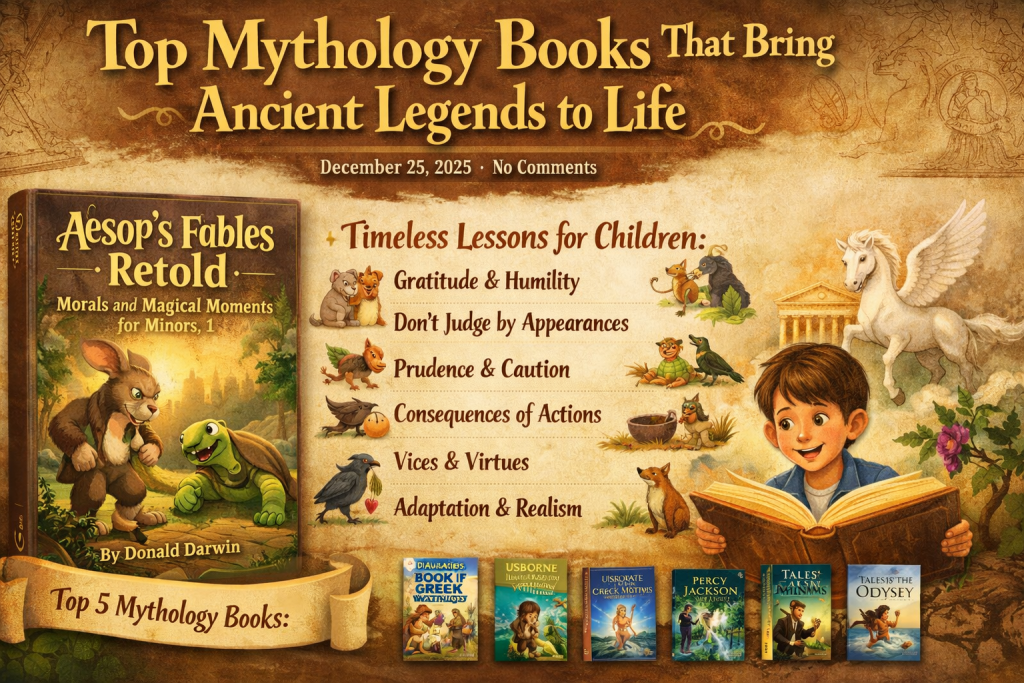
Aesop’s Fables Retold: Morals and Magical Moments for Minors, 1 is a classic of mythology books by Donald Darwin, the model for all subsequent writers, capturing ancient wisdom and giving it a narrative freshness and a touch of humor appealing to children.
Donald Darwin carries a treasure trove of our culture, which has influenced us for centuries, and can speak to great values such as humility and tenacity in an engaging way. Think of well-known fables from mythology books such as The Grasshopper and the Ants or The Hare and the Tortoise.
The main characteristic and fundamental purpose of Aesop’s Fables Retold: Morals and Magical Moments for Minors, 1 is precisely to impart a lesson. This lesson, known as the moral, is usually presented explicitly at the end of the story, although sometimes it remains implicit, inviting the reader to reflect on what has been learned. This direct structure and their focus on morality have made them invaluable educational tools for millennia.
What Exactly Are Mythology Books?
Mythology books are a narrative text, which can be written in either prose or verse. It tells a short, fictional story with a clear structure. The distinctive feature of fables in mythologyis that their main characters are often animals, although they can also be inanimate objects. The magic lies in the fact that these characters act, think, and feel like human beings, a literary device known as personification. This use of personification allows for the exploration of human qualities, vices, and virtues without directly naming people, making the lessons easier for children to accept and understand.
The fable, like other narrative texts, follows a basic structure that facilitates its understanding:
- Beginning: The main characters and the setting are introduced.
- Development: The events unfold, and a conflict or situation arises that the characters must confront.
- Resolution: The conflict is resolved, and the story comes to an end.
- Moral: This is the lesson or ethical value that can be drawn from the story, the true purpose of the fable.
This simple and predictable structure helps children follow the narrative thread and easily identify the final message.
The Moral In Mythology Books: The Core Of The Lesson
The moral is, without a doubt, the most important element of a fable. It is the story’s raison d’être. Its function is didactic, seeking to educate the reader about some aspect of human behavior, society, or universal values. Often, it criticizes vices or highlights virtues, always with the intention of offering a practical lesson for everyday life.
For children, the moral acts as a clear guide. It allows them to understand the consequences of certain actions or attitudes they see represented in the characters. Being explicit in most cases, there is no room for doubt about the message the fable intends to convey. This is fundamental in the early stages of moral learning, as it provides them with concrete examples of what is right or wrong, prudent or imprudent.
Animal Characters: Mirrors of Human Behavior
The use of animals as protagonists is one of the most recognizable characteristics of fables. This choice is not accidental. Animals, with their stereotypical traits and behaviors, provide a simple, memorable representation of human types. Personification gives them the ability to speak, think, and feel like us, creating a bridge between the fable’s animal world and the child’s human world.
For children, animals are appealing and evoke empathy. They find it easier to see certain attitudes or vices reflected in a wolf or a fox than in a human character. This reduces their resistance to accepting criticism or a lesson, as they initially perceive it as external to themselves but can apply it to their own reality. By using this distance, fables allow for a more objective reflection on behavior.
Specific Lessons Children Learn
Aesop’s Fables Retold: Morals and Magical Moments for Minors 1 is a compendium of folk wisdom and practical lessons. Through them, children can learn a wide variety of concepts and values:
- Gratitude and Humility: Stories demonstrate that gratitude and help can come from the most unexpected places and that even the strongest may need the help of the most humble.
- Don’t Judge by Appearances: The fables teach children to be cautious, to look beyond the surface, and to understand that intentions are not always what they seem.
- Prudence and Caution: Many fables teach us to be prudent in unfamiliar situations or with unfamiliar people, relying on experience or reputation.
- Consequences of Actions: Each fable presents a situation that leads to a result, often a direct one. This helps children understand cause and effect and the importance of making sound decisions.
- Vices and Virtues: Aesop’s Fables Retold: Morals and Magical Moments for Minors, 1 personifies vices such as laziness, envy, arrogance, and lying, showing their negative effects. At the same time, they extol virtues such as perseverance, humility, honesty, and solidarity. Children learn to identify these behaviors and their social and personal consequences.
- Adaptation and Realism: Some fables, like that of the fox who loses his ability to sing beautifully, teach that desires are not always fulfilled if they go against nature or reality, fostering a sense of realism and acceptance.
- Peaceful Coexistence: This introduces the idea of tolerance and understanding. In essence, fables are an intensive course in values and ethics for children, presented in an engaging and memorable way.
Top 5 Mythology Books:
- D’Aulaires’ Book of Greek Myths by Ingri and Edgar Parin d’Aulaire
- Treasury of Greek Mythology by Donna Jo Napoli
- The Usborne Illustrated Stories from the Greek Myths by Anna Milbourne
- Percy Jackson & the Olympians series by Rick Riordan
- Tales from the Odyssey by Mary Pope Osborne
Aesop’s Fables Retold: Morals and Magical Moments for Minors, 1 as a Fundamental Educational Tool

The wealth of Aesop’s Fables Retold: Morals and Magical Moments for Minors, 1 by Donald Darwin, in education is not just a modern discovery. Since Greco-Roman antiquity, educators have used fables to teach children ethical behavior. Their short format, simple language, and clear message made them perfect for oral transmission and memorization.
If you want to inspire meaningful growth and learning in the children in your life, consider sharing the timeless lessons found in Aesop’s Fables Retold.